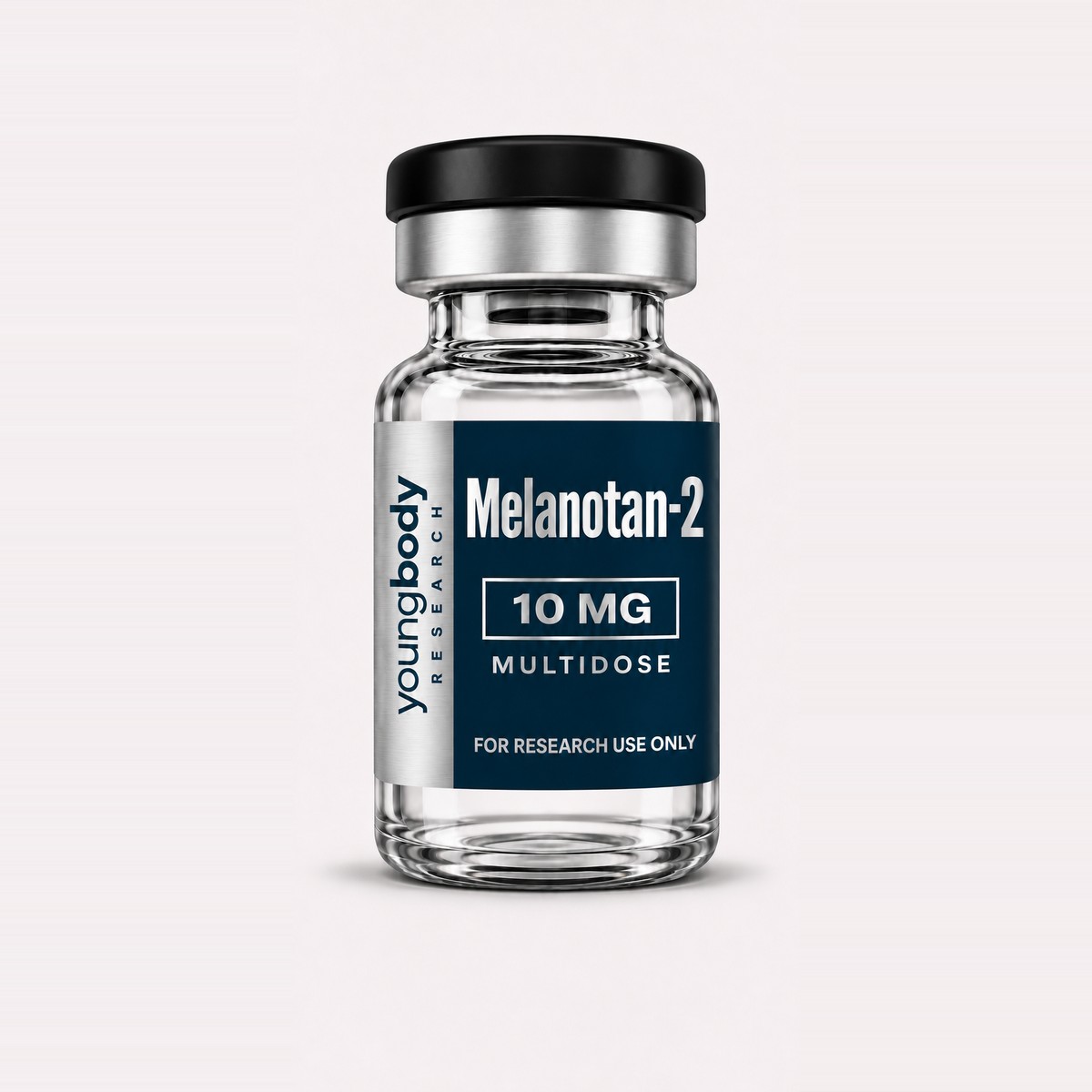
 Certificate of Analysis available for every lot≥99% purity, HPLC & mass-spec verifiedFor research use only. Not for human consumption.
Melanotan-2 (MT-2) is a cyclic synthetic peptide that acts as an agonist at melanocortin receptors. It is supplied for laboratory research on receptor pharmacology and signaling.
Molecular Formula: C62H98N16O22
Molecular Weight: 1419.556 g/mol
Sequence: Gly-Glu-Pro-Pro-Pro-Gly-Lys-Pro-Ala-Asp-Asp-Ala-Gly-Leu-Val
CAS #: 137525-51-0
Purity: 99% HPLC
MT-2 serves as a defined-sequence agonist in receptor binding assays and in cAMP and ERK signaling readouts. It is also used as a probe in rodent neurobehavioral paradigms and in pigmentation-signaling studies in cells. Tissue and region mapping of receptor expression is another use. All of these are laboratory research uses.
MT-2 is described as acting on the melanocortin receptor family (MC1R to MC5R). These GPCRs commonly couple to Gs and raise cAMP, with downstream PKA and ERK signaling. Researchers often pair it with subtype-selective antagonists or genetic models to work out which receptor produces an observed result.
Rodent studies have used MT-2 in a maternal immune activation model with social-behavior readouts, and in models of alcohol intake, alone or together with naltrexone. Other work looked at melanocortin signaling in feeding behavior and in glucose uptake after hypothalamic injection. These are laboratory and animal-model findings only.
Supplied as a lyophilized powder. Identity and purity are normally confirmed by HPLC and mass spectrometry. Refer to the Certificate of Analysis for the lot you receive.
Peptides are shipped lyophilized (freeze-dried), a state that keeps them stable in transit. Keep vials cold and away from light on arrival.

Young Body supplies research compounds exclusively to qualified researchers and laboratories for in vitro and laboratory use. Please confirm before continuing.
By proceeding you affirm the statements above are true. Products are not for human or veterinary use, not for use in diagnostic procedures, and have not been evaluated by the U.S. Food and Drug Administration.
